The NCC is the planner for federal lands and assets in the National Capital Region. In this capacity, the NCC works in collaboration with partners and stakeholders to enhance the region’s urban, natural and cultural character.
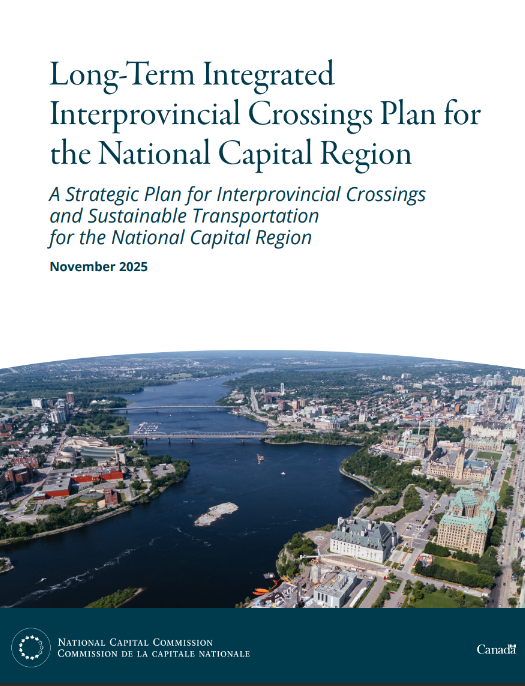
We are working to make the National Capital Region a model of land use and transportation planning. The Long-Term Integrated Interprovincial Crossings Plan is a roadmap that outlines a vision and strategies related to the interprovincial transport of people and goods in the National Capital Region.
About the plan
The Long-Term Integrated Interprovincial Crossings Plan guides the NCC and its partners in their work to build a more efficient and sustainable interprovincial transportation system in the National Capital Region.
The plan was initially approved by the NCC Board of Directors in 2022. The sections concerning current and projected conditions were updated in 2025 to incorporate post-pandemic data on travel and commercial goods movement, as well as recent government decisions about transportation infrastructure in the National Capital Region.
Vision
The plan proposes short-, medium- and long-term strategies to deliver on this vision.
"The Long-Term Integrated Interprovincial Crossings Plan presents the desired future of transportation in the National Capital Region. It states that by 2050, the transportation network to cross the Ottawa River will provide well-connected and sustainable travel options that contribute to a high quality of life and economic prosperity in the National Capital Region. The system of crossings will support equitable mobility and the safe and efficient movement of people and goods, while respecting the region’s natural environment and cultural heritage."
Update to regional data
The 2025 update to the plan was also an opportunity to refresh regional data to better understand post-pandemic travel and interprovincial truck travel trends.
Origin Destination Survey
The TRANS Committee coordinates efforts between National Capital Region planning agencies. In 2022, the Committee conducted a regional origin-destination survey that provides a snapshot in time of all trips made by residents of the National Capital Region during that period.
Results were compared to previous surveys in 2005 and 2011 to identify trends.
Findings of the 2022 survey
- a 3% increase in the number of trips from households between 2011 and 2022;
- fewer daily trips per person and more varied types of trips;
- a decrease in utilitarian trips (work/school) and an increase in discretionary trips (recreational/shopping);
- a 25% decrease in daily interprovincial trips in both directions;
- an increase in interprovincial walking and cycling trips, by 56% and 43% respectively.
The full survey results are available on the TRANS committee website.
Since the survey, regional agencies continue to monitor the evolution of the return to office and the increase in transit ridership.
Interprovincial Truck Mobility Data Collection
In 2023, the NCC collected information on interprovincial truck travel in the region. The data collected will support regional transportation planning studies.
Findings from the collection
- Approximately 3,500 weekday interprovincial truck trips take place in the National Capital Region, which represents 2% of all interprovincial vehicle traffic.
- 85% of interprovincial truck trips were observed between 6 am and 6 pm.
- 67% of trucks observed on the King Edward-Rideau-Waller-Nicholas corridor did not have origins or destinations in the immediate downtown core area.
- 75% of truck movements across the Ottawa River have either an origin or a destination east of the Rideau and Gatineau rivers.
- 6% of interprovincial truck trips are through traffic (no origin or destination in the National Capital Region).
Actions
In the short term
The NCC is also working to:
- increase the number of electric vehicle charging stations and adopt a zero-emissions fleet;
- improve cycling infrastructure along key interprovincial routes;
- expand programs to encourage sustainable transportation at federal workplaces.
Over the next five to 10 years
The plan also covers actions that need longer-term decision-making or capital investments. These include:
- improving the integration of the interprovincial transit system and service;
- coordinating interprovincial mobility sharing programs (i.e. e-scooters, bike sharing and so on);
- encouraging the use of zero-emission vehicles;
- encouraging transition to low-carbon and smaller vehicles for goods movement.
In the long term
The NCC has also identified long-term actions that require further study, including implementing an interprovincial transit loop within the core area to enhance connectivity.
Public engagement
The feedback provided by more than 3,000 participants informed the drafting of the plan. Summaries of public input collected during each of phase of consultation are available in the reports linked below.

Documents
- Long Term Integrated Interprovincial Crossings Plan for the National Capital Region: Approved Plan (37.76 MiB)
- NCC Report - Truck mobility data collection - June 2024 (18.19 MiB)
- Summary Report: Round 1 of Consultation (840.13 KiB)
- Summary Report: Round 2 of Consultation (3.57 MiB)
- FAQ - Roadside Survey (232.38 KiB)
- FAQ - Establishment Survey (234.28 KiB)